
In the United States and Canada, The sizes of electrical conductors are expressed in AWG (American Wire Gauge), while in Europe, Asia and most international markets are used square millimeters (mm²).
Due to this difference, engineers, Electricians and cable buyers frequently need a AWG to mm² conversion table Accurate to compare cable sizes and select the right conductor for each application.
For any queries related to AWG to mm2 conversion, contact Dosense Cable, he cable manufacturer.
What is AWG?
AWG (American Wire Gauge) is a standardized system used primarily in the United States and Canada to define the diameter of solid and nonferrous electrical conductors.
The AWG system works in reverse:
- Smaller AWG numbers = larger conductor diameter
- Larger AWG numbers = smaller conductor diameter
For example:
- 4/0 AWG is much larger than 10 AWG
- 10 AWG is larger than 20 AWG
Since most international standards use mm², AWG to mm² conversion is essential in global cable trade.
Why convert AWG to mm²?
Converting from AWG to mm² is important for several reasons:
1. International cable selection
Many countries specify cables in mm², while American standards use AWG. Conversion guarantees compatibility.
2. Current Capacity Comparison
The cross-sectional area of the conductor directly affects the current carrying capacity (ampacity). Knowing the equivalence allows for more precise estimates.
3. engineering design
Electrical calculations according to IEC standards require the use of mm².
4. Purchasing and manufacturing
Buyers frequently compare AWG cables to metric cables when sourcing internationally.
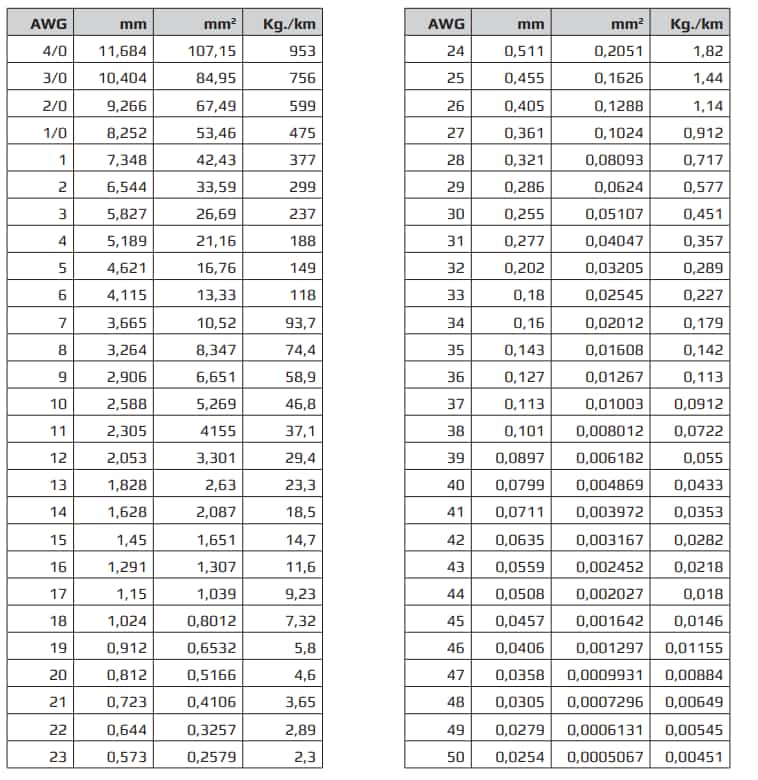
AWG to mm² conversion table
Below is a complete conversion table, including conductor diameter and approximate weight of copper:
| AWG | Diameter (mm) | Area (mm²) | Weight (kg/km) |
|---|---|---|---|
| 4/0 | 11.684 | 107.15 | 953 |
| 3/0 | 10.404 | 84.95 | 756 |
| 2/0 | 9.266 | 67.49 | 599 |
| 1/0 | 8.252 | 53.46 | 475 |
| 1 | 7.348 | 42.43 | 377 |
| 2 | 6.544 | 33.59 | 299 |
| 3 | 5.827 | 26.69 | 237 |
| 4 | 5.189 | 21.16 | 188 |
| 5 | 4.621 | 16.76 | 149 |
| 6 | 4.115 | 13.33 | 118 |
| 7 | 3.665 | 10.52 | 93.7 |
| 8 | 3.264 | 8.347 | 74.4 |
| 9 | 2.906 | 6.651 | 58.9 |
| 10 | 2.588 | 5.269 | 46.8 |
| 11 | 2.305 | 4.155 | 37.1 |
| 12 | 2.053 | 3.301 | 29.4 |
| 13 | 1.828 | 2.63 | 23.3 |
| 14 | 1.628 | 2.087 | 18.5 |
| 15 | 1.45 | 1.651 | 14.7 |
| 16 | 1.291 | 1.307 | 11.6 |
| 17 | 1.15 | 1.039 | 9.23 |
| 18 | 1.024 | 0.8012 | 7.32 |
| 19 | 0.912 | 0.6532 | 5.8 |
| 20 | 0.812 | 0.5166 | 4.6 |
| 21 | 0.723 | 0.4106 | 3.65 |
| 22 | 0.644 | 0.3257 | 2.89 |
| 23 | 0.573 | 0.2579 | 2.3 |
| 24 | 0.511 | 0.2051 | 1.82 |
| 25 | 0.455 | 0.1626 | 1.44 |
| 26 | 0.405 | 0.1288 | 1.14 |
| 27 | 0.361 | 0.1024 | 0.912 |
| 28 | 0.321 | 0.08093 | 0.717 |
| 29 | 0.286 | 0.0624 | 0.577 |
| 30 | 0.255 | 0.05107 | 0.451 |
| 31 | 0.227 | 0.04047 | 0.357 |
| 32 | 0.202 | 0.03205 | 0.289 |
| 33 | 0.180 | 0.02545 | 0.227 |
| 34 | 0.160 | 0.02012 | 0.179 |
| 35 | 0.143 | 0.01608 | 0.142 |
| 36 | 0.127 | 0.01267 | 0.113 |
Common equivalences AWG to mm²
Some common conversions include:
- 12 AWG = 3.31 mm²
- 10 AWG = 5.26 mm²
- 8 AWG = 8.37 mm²
- 6 AWG = 13.3 mm²
- 4 AWG = 21.1 mm²
- 2 AWG = 33.6 mm²
- 1/0 AWG = 53.5 mm²
They are commonly used in:
- Electrical installations in buildings
- automotive cables
- Solar systems
- battery cables
- Industrial power cables
How to convert AWG to mm²?
The basic formula is: mm2=π4×d2mm^2 = frac{\pi}{4} \times d^2mm2=4π×d2
Where d is the diameter of the conductor in millimeters.
However, since AWG follows a logarithmic scale, most engineers use standard tables instead of manual calculations.
AWG vs mm²: which is better?
No system is better; they are simply used in different regions:
AWG is mainly used in:
- USA
- Canada
mm² is mainly used in:
- Europa
- Asia
- Middle East
- Africa
For international projects, Understanding the conversion is key to avoiding technical errors.
Conclusion
Understanding the conversion from AWG to mm² is essential in:
- electrical engineering
- Cable manufacturing
- International purchases
Using an accurate table allows:
- Select the correct driver size
- Compare international standards
- Ensure current capacity
- Optimize purchasing decisions
Whether you're designing electrical systems or purchasing cables, Having an AWG to mm² table will help you improve accuracy and save time.