
Introduction
He submarine cable with XLPE/EPR insulation according to IEC standard It is a fundamental element in modern electrical energy transmission and distribution systems.. In offshore energy infrastructure projects, interconnections between islands, offshore wind farms and coastal links, The reliability of the submarine cable is a critical factor for the security and continuity of the electrical supply.
The use of XLPE insulation (cross-linked polyethylene), combined with a design in accordance with IEC standards, allows manufacturing submarine cables capable of operating stably from medium voltage (5kV) until very high voltage (230kV), even in severe marine conditions.
Complete technique of XLPE submarine cable according to IEC, incorporating Detailed tables of conductor sections according to IEC and ASTM standards, with the aim of serving as a reference for engineers, project developers and EPC companies.
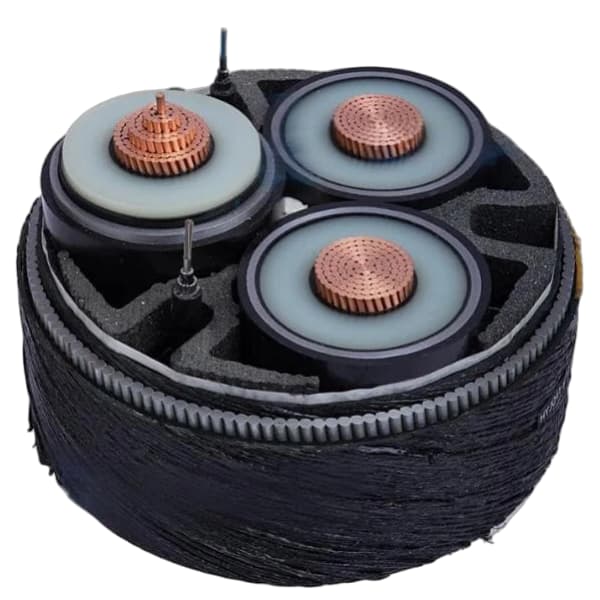
IEC standards applicable to XLPE/EPR submarine cables
XLPE insulated submarine cables are manufactured in strict compliance with the following international standards:
- IEC 60502-2: Power cables with extruded insulation up to 30 kV
- IEC 60840: Cables de alta tensión con aislamiento extruido >30 kV hasta 150 kV
- IEC 62067: Very high voltage cables above 150 kV
- IEC 60228: Copper and aluminum conductors
- IEC 60229 / IEC 60332: Mechanical and environmental tests
These standards guarantee the international compatibility of the cable and its acceptance in global projects..
Typical structure of XLPE/EPR submarine cable
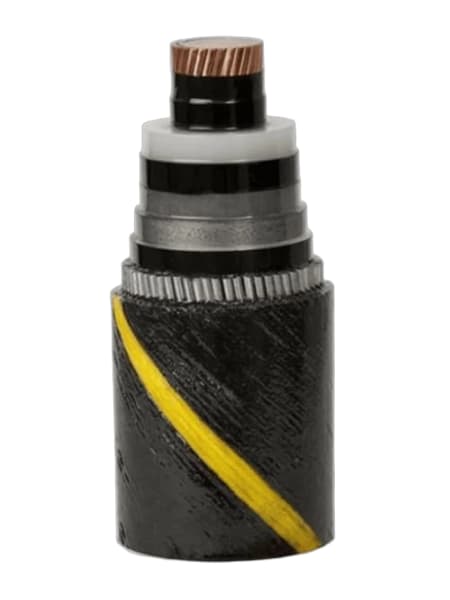
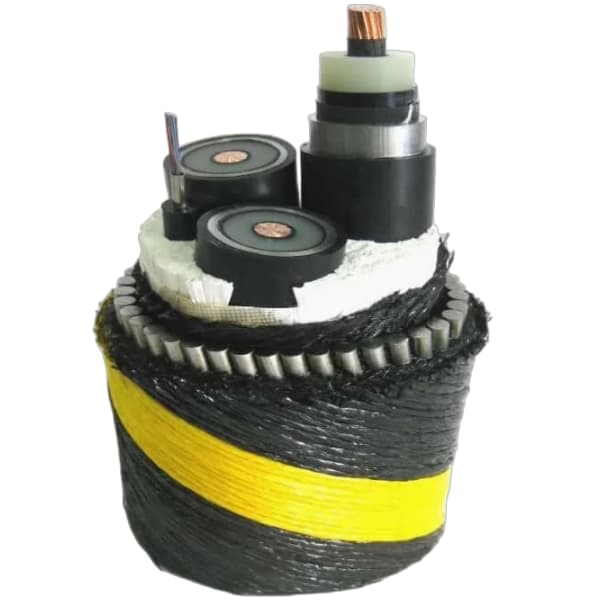
An IEC XLPE insulated submarine cable is composed of multiple layers designed to fulfill electrical functions, mechanical and environmental:
- Conductor (copper or aluminum, IEC o ASTM)
- Driver semiconductor screen
- XLPE insulation
- Semiconductor Insulation Screen
- Metal screen (copper tapes or wires)
- Moisture barrier
- inner cover
- Galvanized steel armor (simple o doble)
- Outer shell resistant to the marine environment
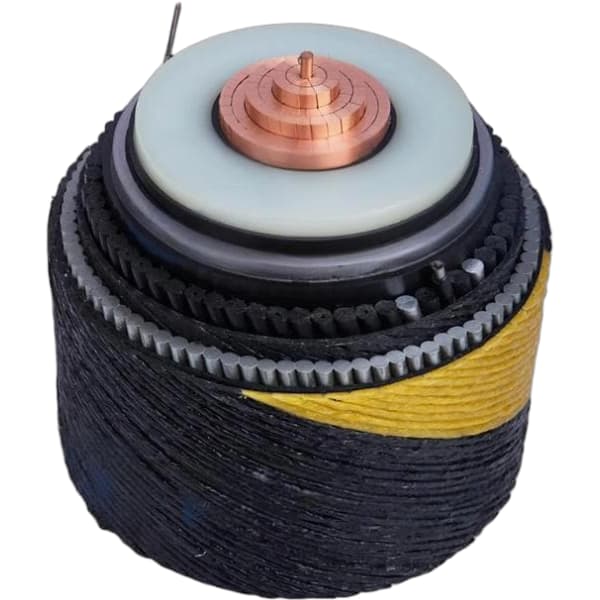
Classification of XLPE/EPR submarine cable by voltage level
5kV – 10kV – 15kV – 20kV (Medium voltage)
XLPE submarine cables 5kV, 10kV, 15kV y 20kV are mainly used in:
- Port facilities
- Plataformas offshore
- Marine industrial networks
- Submarine equipment power
They comply with IEC 60502-2 and allow flexible designs with reduced diameters.
33kV (Medium-high voltage)
He 33kV submarine cable It is one of the most used in marine energy projects, especially in:
- Offshore wind farms
- Coastal interconnections
- Regional distribution systems
This voltage level represents an optimal balance between transmission capacity and ease of installation..
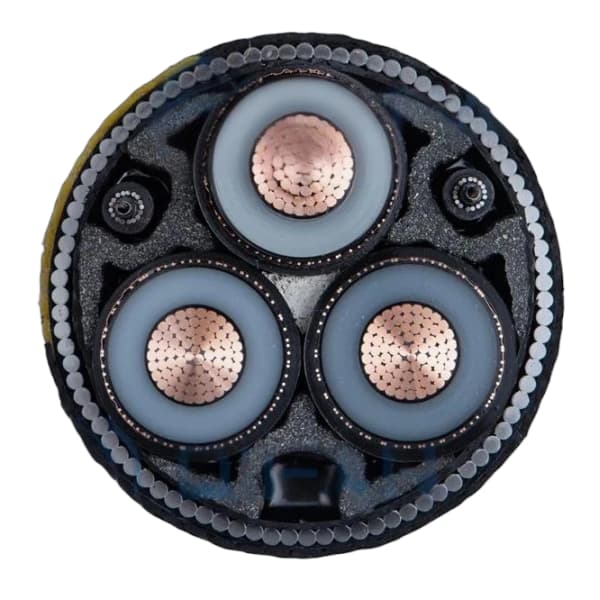
66kV y 132kV (High voltage)
The submarine cables 66kV y 132kV, designed according to IEC 60840, are used in:
- Electrical interconnections between islands
- Energy export from offshore wind farms
- High capacity underwater networks
Require advanced electric field control design and reinforced insulation.
230kV (Very high voltage)
He 230kV XLPE submarine cable, according to IEC 62067, is destined to:
- Strategic submarine transmission projects
- International interconnections
- Large offshore energy systems
These cables represent the highest level of submarine cable engineering..
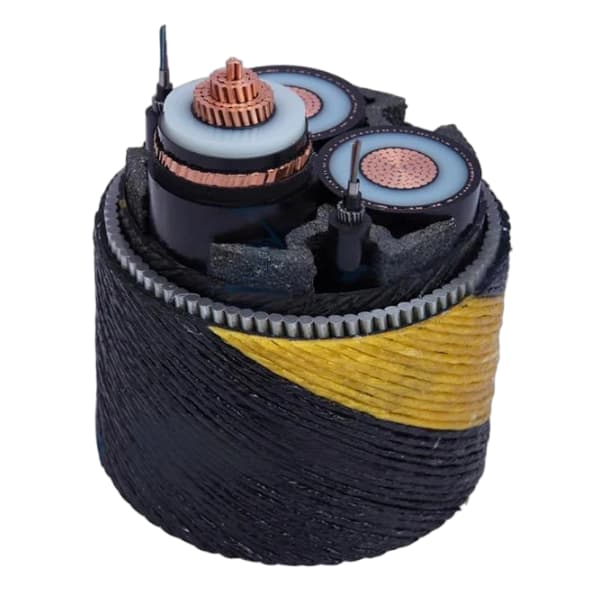
Tabla 1: Conductor sections according to IEC standard (mm²)
IEC standards define the conductor by its cross section in square millimeters (mm²).
| IEC Section (mm²) | Material | Typical applications |
|---|---|---|
| 50 | Cu / Al | Submarine medium voltage |
| 70 | Cu / Al | Coastal networks |
| 95 | Cu / Al | Marine distribution |
| 120 | Cu / Al | Offshore installations |
| 150 | Cu / Al | Medium-high voltage |
| 185 | Cu / Al | Wind farms |
| 240 | Cu / Al | High capacity |
| 300 | Cu / Al | Regional transmission |
| 400 | Cu / Al | Underwater high voltage |
| 500 | Cu / Al | Export cables |
| 630 | Cu / Al | Interconnection |
| 800 | Cu / Al | High power |
| 1000 | Cu / Al | High voltage |
| 1200 | Cu / Al | Special projects |
| 1600 | Cu / Al | Long distance |
| 2000 | Cu / Al | Very high power |
| 2500 | Cu / Al | Strategic projects |
Tabla 2: Conductor sections according to ASTM standard (AWG / kcmil)
In projects that follow American standards, conductors defined by ASTM / AWG / kcmil.
| ASTM size | Approx area. (mm²) | Applications |
|---|---|---|
| AWG 1/0 | 53.5 | Medium voltage |
| AWG 2/0 | 67.4 | Underwater networks |
| AWG 3/0 | 85.0 | Distribution |
| AWG 4/0 | 107.2 | Offshore |
| 250 kcmil | 126.7 | Medium-high voltage |
| 350 kcmil | 177.3 | Wind farms |
| 500 kcmil | 253.4 | High capacity |
| 750 kcmil | 380.0 | Transmission |
| 1000 kcmil | 506.7 | High voltage |
| 1250 kcmil | 633.4 | Export cables |
| 1500 kcmil | 760.1 | Long distance |
| 1750 kcmil | 886.8 | Very high power |
| 2000 kcmil | 1013.4 | Offshore projects |
| 2500 kcmil | 1266.8 | Very high voltage |
Driver material: copper and aluminum
- Copper (Cu)
- Higher conductivity
- Smaller section
- Ideal for limited spaces
- Aluminum (Al)
- Lower weight
- Cost optimization
- Widely used in long underwater transmission
Both comply with IEC 60228 and corresponding ASTM.
Armor and mechanical protection
The submarine cable incorporates galvanized steel armor to:
- Mechanical protection
- Resistance to marine currents
- Support during installation
The armor can be single or double depending on the depth and the seabed..
Testing and quality control
Each IEC compliant XLPE submarine cable is subject to:
- Applied voltage test
- Partial discharge measurement
- Thermal tests
- mechanical tests
- Leakage tests
Advantages of XLPE/EPR submarine cable according to IEC
- Wide voltage range (5kV–230kV)
- IEC and ASTM Compatibility
- High electrical reliability
- Long lifespan
- Excellent marine resistance
Submarine cable with XLPE/EPR insulation according to IEC standard
He XLPE insulated submarine cable according to IEC standard for electrical transmission from 5kV to 230kV. is the most reliable solution for modern underwater electrical transmission. Thanks to its advanced design, regulatory compliance and compatibility with IEC and ASTM conductor sections, These cables meet the needs of energy projects from 5kV to 230kV.
Choose a specialized manufacturer of XLPE submarine cables guarantees security, long-term performance and success in offshore and electrical interconnection projects.