
Introduction to 33kV submarine cable
He 33kV submarine cable manufacturer plays a critical role in the development of modern marine energy infrastructure. In recent years, the expansion of offshore wind farms, Electrical interconnections between islands and oil and gas platforms have significantly increased the demand for medium voltage submarine cables..
Besides, the cables of 33kV have become a widely used standard in marine energy projects. For example, in offshore wind farms, These cables connect the turbines with the marine substations. Posteriorly, The energy is transmitted to the ground through high voltage cables.
Therefore, and 33kV submarine cable manufacturer must design cables capable of withstanding extremely demanding conditions, including underwater pressure, salt corrosion, mechanical impacts and thermal stresses. To achieve, Manufacturers use advanced materials such as copper or aluminum conductors, isolation XLPE o EPR, Heavy duty metal armor and durable outer covers.
Consequently, Choosing an experienced manufacturer is crucial to ensure safety, efficiency and durability of underwater electrical systems
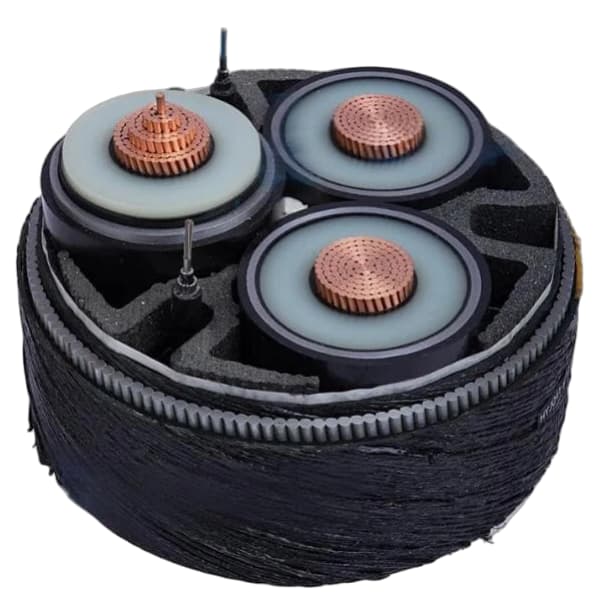
What is a 33kV submarine cable?
An underwater cable 33kV is an electrical cable specifically designed to transmit power underwater. Unlike ground cables, These cables must withstand extreme marine conditions for decades.
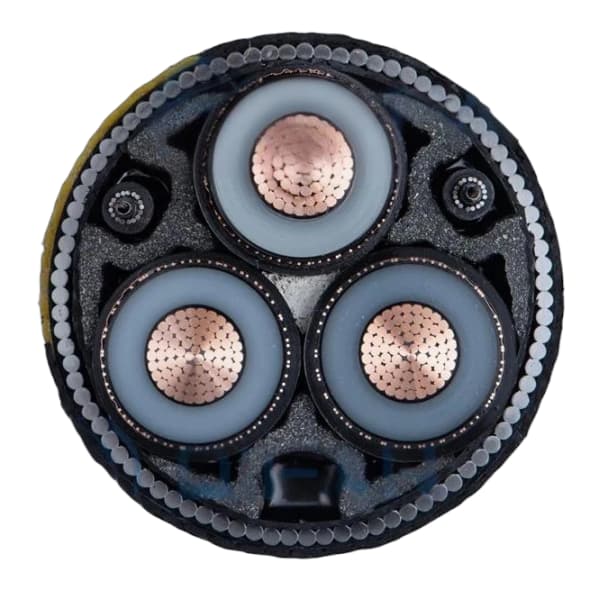
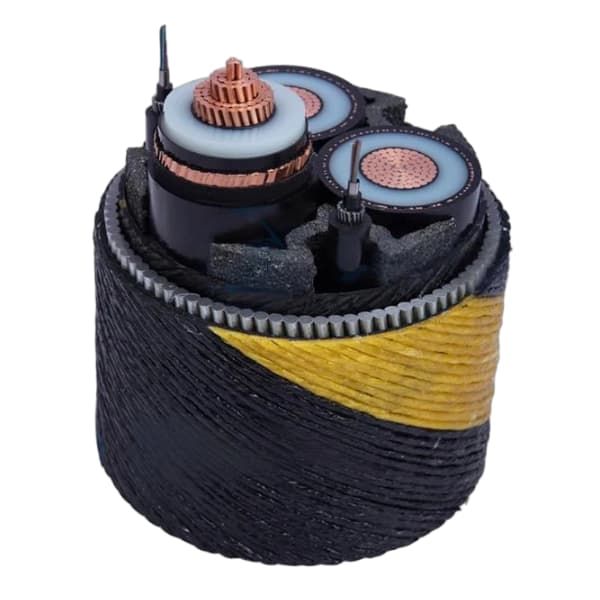
Generally, and 33kV submarine cable manufacturer Design the cable with multiple layers of protection. Each layer performs a specific function to ensure electrical performance and mechanical resistance.
The main layers include:
- electrical conductor
- conductive screen
- electrical insulation
- Metal screen
- inner cover
- mechanical armor
- protective outer cover
Thanks to this multi-layer structure, the cable can operate safely during 25 a 30 years in underwater environments.
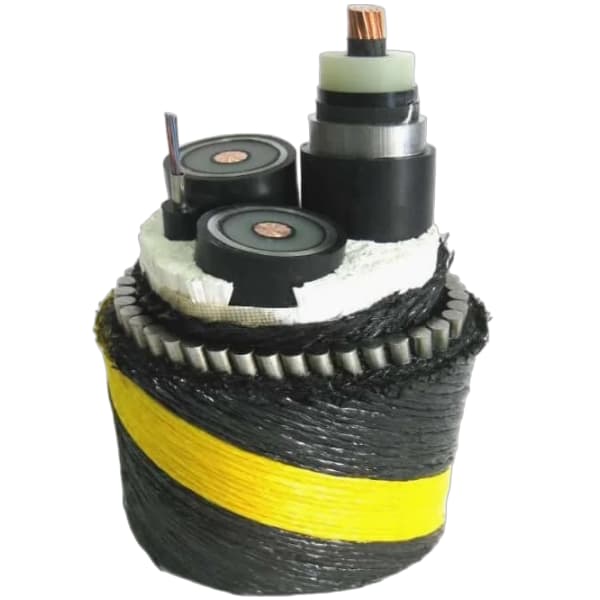
Typical structure of 33kV submarine cable
Conductor
The conductor is the main component responsible for carrying electrical current. And 33kV submarine cable manufacturer usually uses two materials:
- copper
- aluminum
Copper offers greater electrical conductivity and lower resistance. However, aluminum is lighter and reduces overall cable cost.
Isolation
Electrical insulation prevents current leakage and electrical failure. The most used materials are:
- XLPE (Cross-linked polyethylene)
- EPR (Ethylene propylene rubber)
XLPE insulation is known for its excellent thermal and electrical resistance. On the other hand, EPR offers greater flexibility and excellent moisture resistance.
Metal screen
The metal shield controls the electric field and improves the safety of the cable. It is usually made with copper wires or tapes..
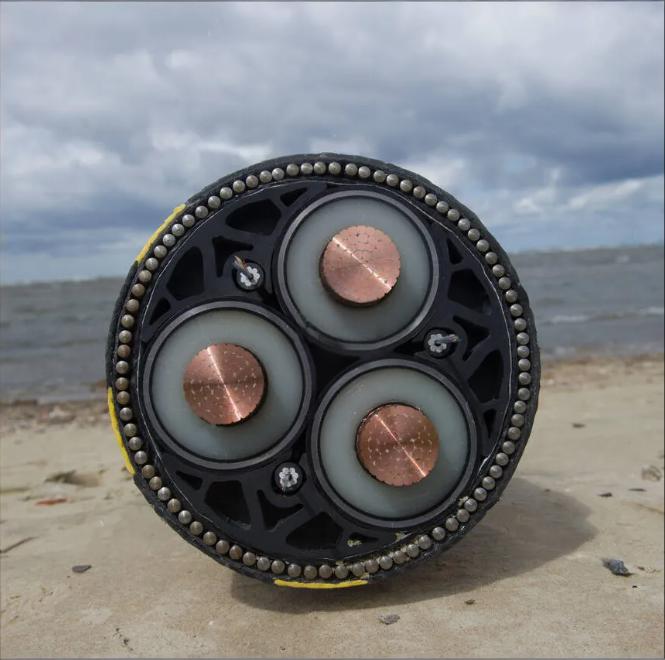
Armor
Armor provides mechanical protection against damage during installation and operation.
The most common types include:
- galvanized steel wire armor
- aluminum wire armor
External cover
Finally, Outer sheath protects cable from corrosion, abrasion and marine organisms.
The most used materials are:
- PE (polyethylene)
- PVC (polyvinyl chloride)
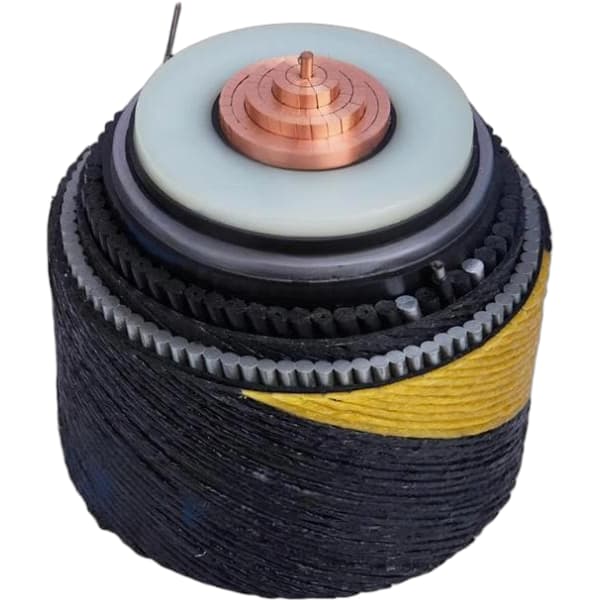
IEC conductor sizes for 33kV submarine cable
And 33kV submarine cable manufacturer normally follows IEC standards for conductor size.
| Driver section (mm²) | Driver type | Material | Application |
|---|---|---|---|
| 25 | compact circular | Cu / Al | small underwater nets |
| 35 | compact circular | Cu / Al | offshore connection |
| 50 | compact circular | Cu / Al | marine systems |
| 70 | compact circular | Cu / Al | electric transmission |
| 95 | compact circular | Cu / Al | interconnection |
| 120 | compact circular | Cu / Al | marine energy |
| 150 | compact circular | Cu / Al | offshore |
| 185 | compact circular | Cu / Al | wind farms |
| 240 | compact circular | Cu / Al | industrial projects |
| 300 | segmented | Cu / Al | transmission |
| 400 | segmented | Cu / Al | submarine interconnection |
| 500 | segmented | Cu / Al | high capacity |
| 630 | segmented | Cu / Al | offshore wind farms |
| 800 | segmented | Cu / Al | energy projects |
| 1000 | segmented | Cu / Al | high power transmission |
| 1200 | segmented | Cu / Al | marine infrastructure |
| 1600 | segmented | Cu / Al | big projects |
| 2000 | segmented | Cu / Al | underwater transmission |
ASTM Conductors (20 AWG – 1000 MCM)
In addition to IEC sizes, many international projects require drivers based on standards ASTM / AWG. For this reason, and 33kV submarine cable manufacturer must be able to produce cables with these sizes.
| ASTM size | Area mm2 | Conductor | Isolation | Armor | Deck |
|---|---|---|---|---|---|
| 20 AWG | 0.52 | Cu / Al | XLPE / EPR | steel / aluminum | PE / PVC |
| 18 AWG | 0.82 | Cu / Al | XLPE / EPR | steel / aluminum | PE / PVC |
| 16 AWG | 1.31 | Cu / Al | XLPE / EPR | steel / aluminum | PE / PVC |
| 14 AWG | 2.08 | Cu / Al | XLPE / EPR | steel / aluminum | PE / PVC |
| 12 AWG | 3.31 | Cu / Al | XLPE / EPR | steel / aluminum | PE / PVC |
| 10 AWG | 5.26 | Cu / Al | XLPE / EPR | steel / aluminum | PE / PVC |
| 8 AWG | 8.37 | Cu / Al | XLPE / EPR | steel / aluminum | PE / PVC |
| 6 AWG | 13.3 | Cu / Al | XLPE / EPR | steel / aluminum | PE / PVC |
| 4 AWG | 21.2 | Cu / Al | XLPE / EPR | steel / aluminum | PE / PVC |
| 3 AWG | 26.7 | Cu / Al | XLPE / EPR | steel / aluminum | PE / PVC |
| 2 AWG | 33.6 | Cu / Al | XLPE / EPR | steel / aluminum | PE / PVC |
| 1 AWG | 42.4 | Cu / Al | XLPE / EPR | steel / aluminum | PE / PVC |
| 1/0 AWG | 53.5 | Cu / Al | XLPE / EPR | steel / aluminum | PE / PVC |
| 2/0 AWG | 67.4 | Cu / Al | XLPE / EPR | steel / aluminum | PE / PVC |
| 3/0 AWG | 85.0 | Cu / Al | XLPE / EPR | steel / aluminum | PE / PVC |
| 4/0 AWG | 107 | Cu / Al | XLPE / EPR | steel / aluminum | PE / PVC |
| 250 MCM | 127 | Cu / Al | XLPE / EPR | steel / aluminum | PE / PVC |
| 300 MCM | 152 | Cu / Al | XLPE / EPR | steel / aluminum | PE / PVC |
| 350 MCM | 177 | Cu / Al | XLPE / EPR | steel / aluminum | PE / PVC |
| 400 MCM | 203 | Cu / Al | XLPE / EPR | steel / aluminum | PE / PVC |
| 500 MCM | 253 | Cu / Al | XLPE / EPR | steel / aluminum | PE / PVC |
| 600 MCM | 304 | Cu / Al | XLPE / EPR | steel / aluminum | PE / PVC |
| 750 MCM | 380 | Cu / Al | XLPE / EPR | steel / aluminum | PE / PVC |
| 800 MCM | 405 | Cu / Al | XLPE / EPR | steel / aluminum | PE / PVC |
| 900 MCM | 456 | Cu / Al | XLPE / EPR | steel / aluminum | PE / PVC |
| 1000 MCM | 507 | Cu / Al | XLPE / EPR | steel / aluminum | PE / PVC |
Typical technical parameters table
And 33kV submarine cable manufacturer Provides detailed technical parameters for each cable.
| Section mm² | Conductor diameter (mm) | Insulation thickness (mm) | Armor thickness (mm) | External diameter (mm) |
|---|---|---|---|---|
| 35 | 7.0 | 8.0 | 4.0 | 65 |
| 70 | 9.5 | 8.0 | 4.5 | 72 |
| 120 | 12.5 | 8.5 | 5.0 | 80 |
| 185 | 15.0 | 8.5 | 5.5 | 88 |
| 240 | 17.5 | 9.0 | 6.0 | 95 |
| 300 | 19.5 | 9.0 | 6.5 | 100 |
| 400 | 22.5 | 9.5 | 7.0 | 108 |
| 500 | 25.0 | 10.0 | 7.5 | 115 |
| 630 | 28.0 | 10.0 | 8.0 | 125 |
| 800 | 31.5 | 10.5 | 8.5 | 135 |
| 1000 | 35.5 | 11.0 | 9.0 | 145 |
Applications of 33kV submarine cable
The submarine cables 33kV They are widely used in various marine energy applications.
Offshore wind farms
First of all, connect wind turbines with marine substations.
Oil platforms
Besides, supply power to offshore oil and gas facilities.
Interconnection between islands
In addition, allow electricity to be transported between islands and continents.
Coastal infrastructure
Finally, They connect industrial and energy facilities located in coastal areas.
International standards
And 33kV submarine cable manufacturer must comply with international standards.
The most common include:
- IEC 60502
- IEC 60228
- IEC 60840
- IEC 62067
- ICEA S-97-682
These standards guarantee safety, cable quality and reliability.
How to choose a 33kV submarine cable manufacturer
Choosing the right manufacturer is essential for the success of any project.
First, the manufacturer must have experience in offshore projects. Besides, must have international certifications and advanced production capabilities.
In addition, It is important to consider the manufacturing capacity of long cables without splices. Finally, technical support during design and installation is a key factor.
33kV submarine cable manufacturer
He 33kV submarine cable manufacturer plays a crucial role in modern marine energy infrastructure. Thanks to its advanced design, These cables can operate safely in underwater environments for decades.
Besides, the combination of copper or aluminum conductors, isolation XLPE o EPR, Metal armor and protective covers ensure high performance and long life.
Therefore, Selecting a reliable manufacturer not only improves the efficiency of the electrical system, but also significantly reduces long-term operating costs.
For inquiries about submarine cables 20 kV, 22 kV y 24 kV, contact us.